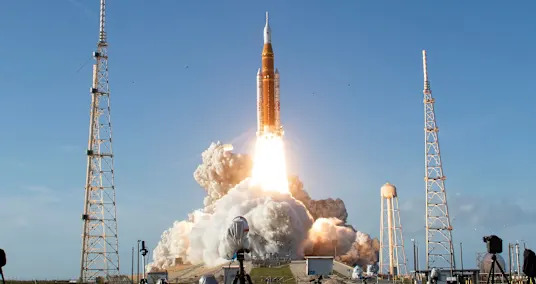
NASA released the first photos of Earth taken by the crew of Artemis II on Friday, hours after the mission left Earth's orbit.
The first photo, taken by Artemis II commander Reid Wiseman, shows the entire planet, and both the Northern and Southern lights are visible over the poles. Zodiacal light, created by sunlight reflecting off dust in the solar system, is visible in the bottom right of the image.
"Hello, World," NASA wrote in the photo caption.
The photo was taken from the window of the Orion capsule, NASA said, after the crew completed their translunar injection burn.
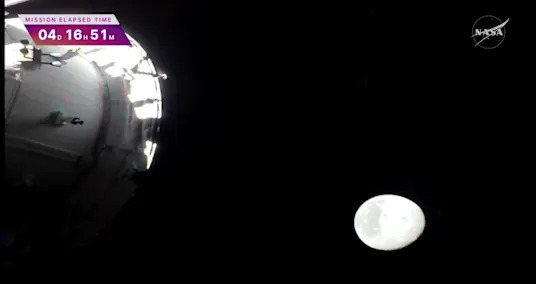
The space agency is also providing a livestream of views from Orion as it travels to and around the moon.

"We see our home planet as a whole, lit up in spectacular blues and browns," NASA wrote on X. "A green aurora even lights up the atmosphere. That's us, together, watching as our astronauts make their journey to the Moon."
Canadian astronaut Jeremy Hansen told NASA's mission control spacecraft communicator that the Artemis II crew was "glued to the window" and "taking pictures" of the planet after breaking out of Earth orbit. In a live conversation with reporters late Thursday night, Wiseman described a moment similar to the one shown in the photograph.
"There was a moment, about an hour ago, where mission control Houston reoriented our spacecraft as the sun was setting behind the Earth…but you could see the entire globe from pole to pole, you could see Africa, Europe, and if you looked really close, you could see the Northern Lights, it was the most spectacular moment, and it paused all four of us in our tracks," Wiseman said at the time.
NASA shared another image that showed a sliver of Earth through the Orion capsule window on X.
The Artemis II is traveling on a trajectory that will carry the astronauts around the far side of the moon on Monday, then bring them back towards Earth. The astronauts aboard the spacecraft are expected to travel farther from Earth than anyone before them, reaching a distance of about 252,021 miles as they pass behind the moon.
In addition to capturing unprecedented images of the far side of the moon, the mission is set to test flight controllers and procedures needed to safely send astronauts back to the moon for long-duration stays as NASA plans for a future moon base.
"This is a test flight," NASA Administrator Jared Isaacman told CBS News. "This is the opening act in a series of missions that will send astronauts to and from the moon with great frequency as we return to stay."
Supreme Court expresses skepticism over Trump order to end birthright citizenship
Watch: Artemis II launches on historic moon mission | Special Report
Iran downs U.S. F-15 fighter jet, sources say | Special Report
LATEST POSTS
- 1
 Kiev declares energy emergency after Russian attacks amid winter cold
- 2My daughter is in the #1 movie in the country. She still has to finish her math homework.
- 3Record-breaking flu hospitalizations in New York in a single week: Health officials
- 4Ancient Egyptian pharaoh's boat is being reassembled in public at the Grand Egyptian Museum
- 5Satellite constellations could obscure most space telescope observations by late 2030s: 'That part of the image will be forever lost'


- Thousands of ultra-orthodox protest in Jerusalem against conscription
- Treason trial of South Sudan's suspended VP is further eroding peace deal, UN experts say
- Robert Pattinson claims he's a pathological liar. What 'The Drama' star has said about his 'shtick'
- Artemis 2 breaks humanity's all-time distance record during historic loop around the moon (video)
- Irish defence minister's trip to Lebanon cancelled
- Vote in favor of the wide open action that revives your brain and soul!
- Two more UN peacekeepers killed in southern Lebanon: UNIFIL
- Recalled "super greens" supplement linked to dozens of salmonella cases, CDC says
- Hundreds of Intact Dinosaur Eggs Emerge From 72-Million-Year Time Capsule